Updated On December 30th, 2025
top10.desc
| Rank | Product Name | Score | |
|---|---|---|---|
| 1 |
|
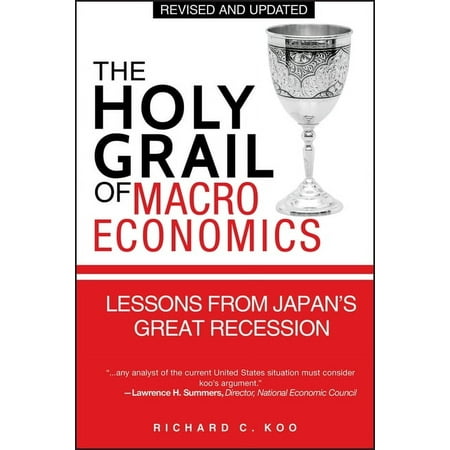
The Holy Grail of Macroeconomics: Lessons from Japan's Great Recession, (Paperback)
Check Price
|
0%
|
| 2 |
|
Dynamic Macroeconomic Theory (Hardcover)
Check Price
|
0%
|
Our Score
The revised edition of this highly acclaimed work presents crucial lessons from Japan's recession that could aid the US and other economies as they struggle to recover from the current financial crisis. This book is about Japan's 15-year long recession and how it affected current theoretical thinking about its causes and cures. It has a detailed explanation on what happened to Japan, but the discoveries made are so far-reaching that a large portion of economics literature will have to be modified to accommodate another half to the macroeconomic spectrum of possibilities that conventional theorists have overlooked. The author developed the idea of yin and yang business cycles where the conventional world of profit maximization is the yang and the world of balance sheet recession, where companies are minimizing debt, is the yin. Once so divided, many varied theories developed in macro economics since the 1930s can be nicely categorized into a single comprehensive theory- The Holy Grail of Macro Economics
The Holy Grail of Macroeconomics: Lessons from Japan's Great Recession, (Paperback) Author: Wiley ISBN: 9780470824948 Format: Paperback Publication Date: 2009-08-01 Page Count: 352
Our Score
The tasks of macroeconomics are to interpret observations on economic aggregates in terms of the motivations and constraints of economic agents and to predict the consequences of alternative hypothetical ways of administering government economic policy. General equilibrium models form a convenient context for analyzing such alternative government policies. In the past ten years, the strengths of general equilibrium models and the corresponding deficiencies of Keynesian and monetarist models of the 1960s have induced macroeconomists to begin applying general equilibrium models. This book describes some general equilibrium models that are dynamic, that have been built to help interpret time-series of observations of economic aggregates and to predict the consequences of alternative government interventions. The first part of the book describes dynamic programming, search theory, and real dynamic capital pricing models. Among the applications are stochastic optimal growth models, matching models, arbitrage pricing theories, and theories of interest rates, stock prices, and options. The remaining parts of the book are devoted to issues in monetary theory; currency-in-utility-function models, cash-in-advance models, Townsend turnpike models, and overlapping generations models are all used to study a set of common issues. By putting these models to work on concrete problems in exercises offered throughout the text, Thomas Sargent provides insights into the strengths and weaknesses of these models of money. An appendix on functional analysis shows the unity that underlies the mathematics used in disparate areas of rational expectations economics. This book on dynamic equilibrium macroeconomics is suitable for graduate-level courses; a companion book, Exercises in Dynamic Macroeconomic Theory, provides answers to the exercises and is also available from Harvard University Press.
Dynamic Macroeconomic Theory (Hardcover)

 日本
日本 US
US