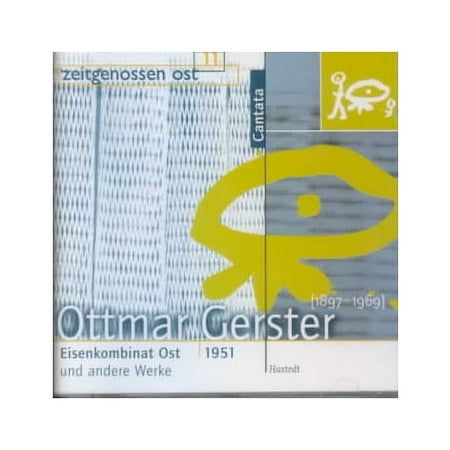
This disc provides a glimpse into a vanished culture, that of the German Democratic Republic in the late 1940s and early 1950s, when idealism and optimism still ran high. Ottmar Gerster was a close contemporary of Paul Hindemith, and with his Frankfurt Conservatory classmate shared an interest in the utility of music as it related to the workers' movement. Unlike Hindemith, however, he became a serious socialist, placing himself in jeopardy by remaining in Germany during the Third Reich, but holding him in good stead when, after the war, East Germany became a socialist republic. The cantata 'Eisenkombinat Ost' is more or less a hymn to hard work, cheering on a building project along the Polish border. The A major Piano Concerto, a somewhat livelier affair, does recall Hindemith in its motoric drive, while the 'Festouverture' celebrating the revolutionary events of 1848 quotes the Internationale and the Marseillaise along with other songs of the people as part of its stolid celebration. Recording quality is mixed: good in the concerto, boxy and dull in the cantata; but one will not hear these pieces anywhere else.

This disc provides a glimpse into a vanished culture, that of the German Democratic Republic in the late 1940s and early 1950s, when idealism and optimism still ran high. Ottmar Gerster was a close contemporary of Paul Hindemith, and with his Frankfurt Conservatory classmate shared an interest in the utility of music as it related to the workers' movement. Unlike Hindemith, however, he became a serious socialist, placing himself in jeopardy by remaining in Germany during the Third Reich, but holding him in good stead when, after the war, East Germany became a socialist republic. The cantata 'Eisenkombinat Ost' is more or less a hymn to hard work, cheering on a building project along the Polish border. The A major Piano Concerto, a somewhat livelier affair, does recall Hindemith in its motoric drive, while the 'Festouverture' celebrating the revolutionary events of 1848 quotes the Internationale and the Marseillaise along with other songs of the people as part of its stolid celebration. Recording quality is mixed: good in the concerto, boxy and dull in the cantata; but one will not hear these pieces anywhere else.
2 photos
(1)
2 stores
1 Products

Product Details

OTTMAR GERSTER: EISENKOMBINAT OST UND ANDERE WERKE

Shop Now

Compare Buying Options

Last Updated: 2025-10-02 09:54:10

Search
Amazon Amazon

$19.98
walmart walmart

Product Specifications

Technical Details

Manufacturer -
Brand -
Item model number -
Color -
Weight -
Height -
Depth -

Additional Product Information

Product Id 3135271
User Reviews and Ratings
3 (1 ratings)
3 out of 5 stars
UPC 691230531121

Shopping Options

Compare Buying Options

# Shop & Price
1
Check on Amazon
Price:
Search Visit Amazon
2
This disc provides a glimpse into a vanished culture, that of the German Democratic Republic in the late 1940s and early 1950s, when idealism and optimism still ran high. Ottmar Gerster was a close contemporary of Paul Hindemith, and with his Frankfurt Conservatory classmate shared an interest in the utility of music as it related to the workers' movement. Unlike Hindemith, however, he became a serious socialist, placing himself in jeopardy by remaining in Germany during the Third Reich, but holding him in good stead when, after the war, East Germany became a socialist republic. The cantata 'Eisenkombinat Ost' is more or less a hymn to hard work, cheering on a building project along the Polish border. The A major Piano Concerto, a somewhat livelier affair, does recall Hindemith in its motoric drive, while the 'Festouverture' celebrating the revolutionary events of 1848 quotes the Internationale and the Marseillaise along with other songs of the people as part of its stolid celebration. Recording quality is mixed: good in the concerto, boxy and dull in the cantata; but one will not hear these pieces anywhere else.
Price:
$19.98 Visit walmart

Top User Reviews and Ratings

No reviews available yet.

Be the first to review this product!